LoRa (Long Range) is a low-power radio protocol designed to send small amounts of data over long distances.
It operates independently of cell towers or the Internet, making it ideal for emergencies when infrastructure fails.
LoRa requires no license to operate.
Meshcore Companions
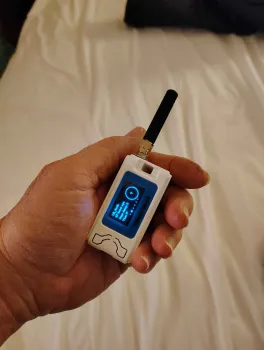
A Meshcore companion is a small LoRa device (about $35.00) programmed with
Meshcore firmware.
Here is the unit I recommend
(see the important notice on the Getting
Started page). It costs about $35.00 when purchased in a two-pack. If you want to place it on a shelf and keep the antenna vertical, you can add a right-angle antenna for about $4.00 more. The device includes an internal battery and can be powered or recharged through USB-C.
The units require basic assembly and firmware installation, but I am happy to handle that for anyone who wants to participate. For those who are more technically inclined, the process is straightforward and easy to learn.
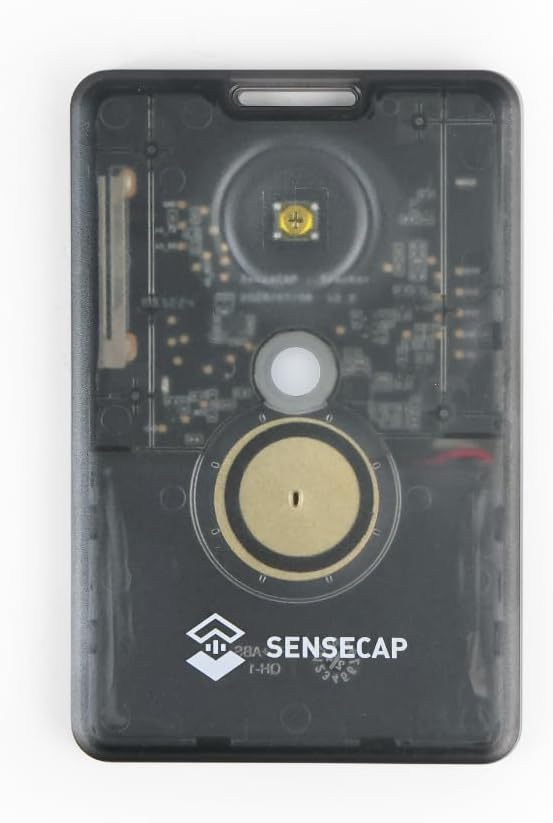
Here is another good unit, the SenseCAP T1000-E. It costs about $50.00, comes fully assembled, is waterproof, and includes a GPS receiver. It is about the size of a credit card but thicker. You do not need the GPS, but you may find sending your location useful. It cannot be charged via USB-C because it uses a special waterproof cable.
How Companions Connect
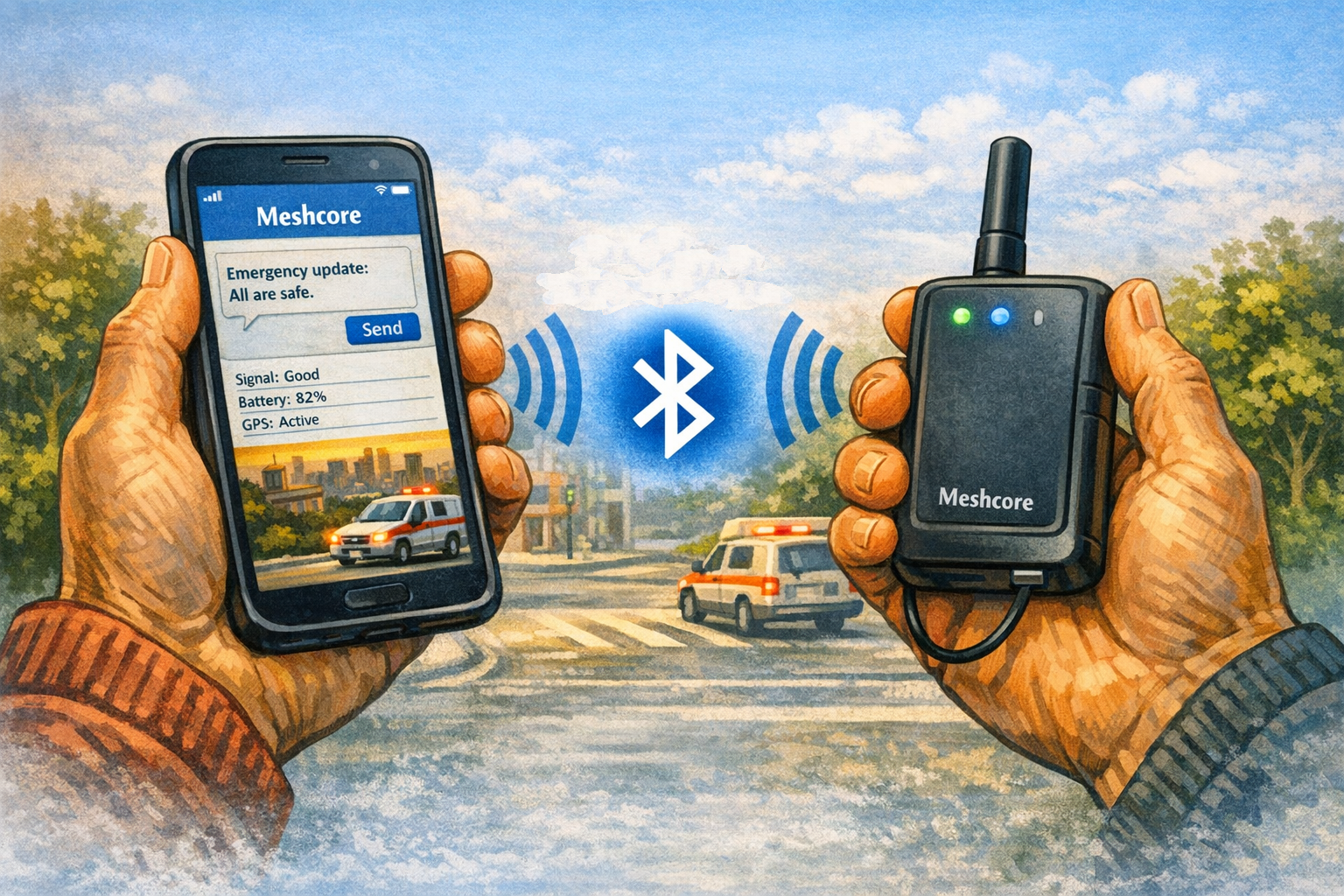
Companions connect to smartphones via Bluetooth.
Bluetooth does not use the cell phone system or WiFi.
It works anywhere.
The
Meshcore companion connects to your phone via Bluetooth.
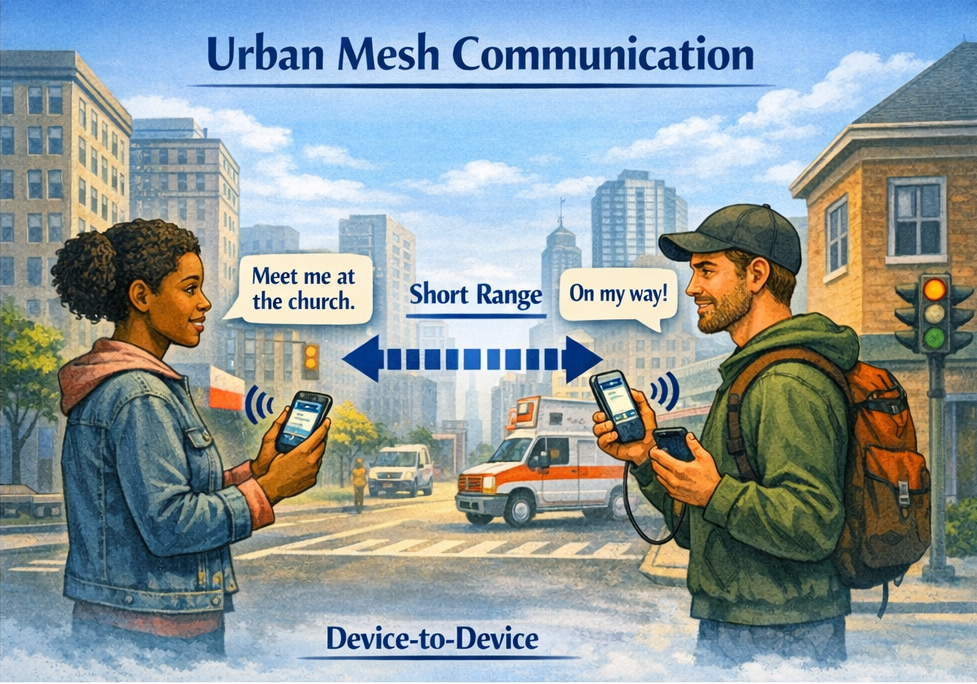
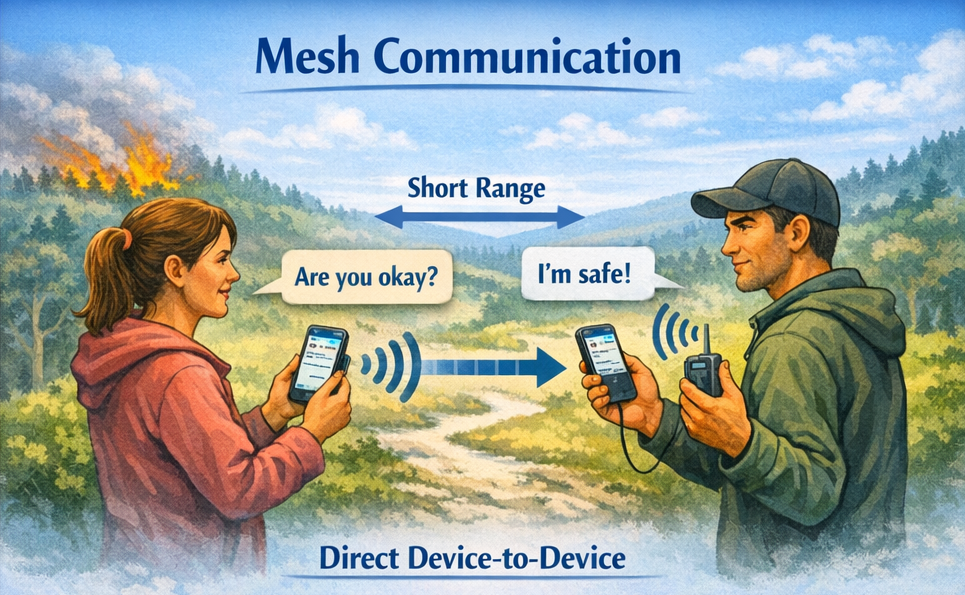
Users send short text messages directly to other users within line of
sight (LoRa's short-wavelength signals can only bend slightly around
obstacles) through the Meshcore app.
Companions
can send messages directly over short distances.
Range varies depending on terrain:
Urban or mountainous areas: limited due to obstructions.
Clear line of sight: several miles or more.
Meshcore is great for communication when you are out of cell phone coverage,
even if your hair isn't on fire.
All messages are encrypted
All Meshcore messages are encrypted. Only those who have
your decryption key can read your messages.
Everyone has the decryption key to thePublic channel.
The public channel is installed automatically when you flash your
unit.
Hashtag channels are public channels.
Anyone can join a channel with a name that begins with a hashtag
(#).
Direct messages, those you send to a specific companion
unit are encrypted. Only the intended recipient will
receive a direct message.
Private channels are by invitation only.
Anyone can create private channels and only those who are invited
can join.
How channels work
All messages are sent on the same frequency. Different channels and direct
messages use different encryption. Only those who have joined a channel or are
the intended recipient of a direct message will see the relevant messages.
Repeaters
Repeaters extend the range of Meshcore communications when obstacles limit
the range.
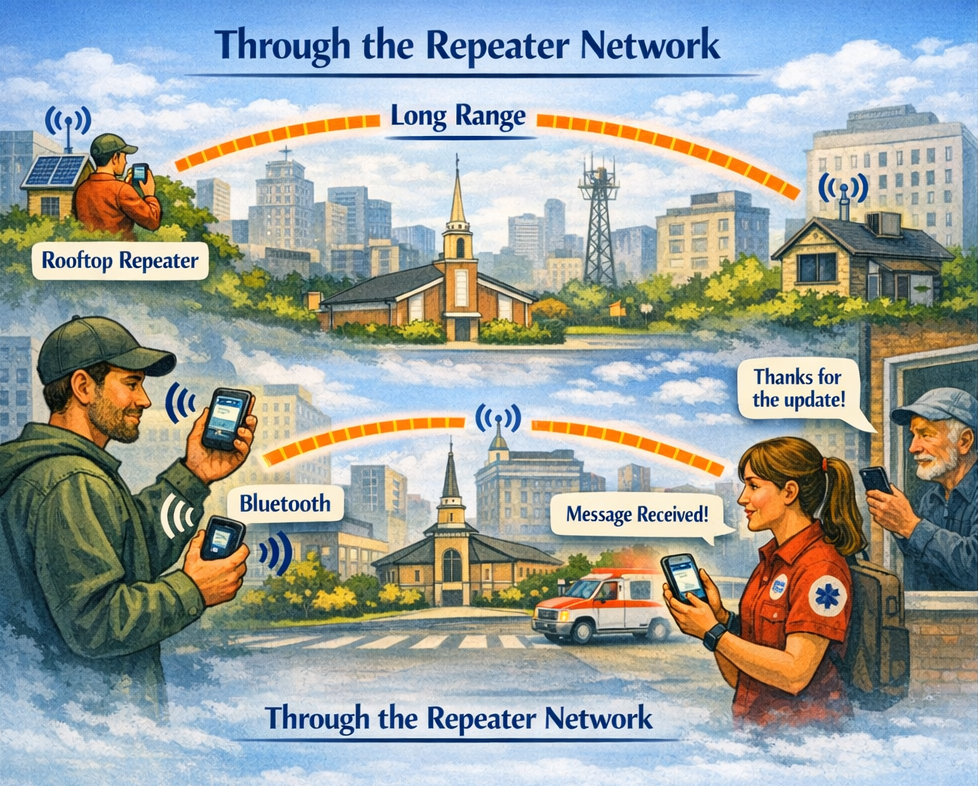
Repeaters extend the reach of companions by relaying messages over and
around mountains,large buildings or in and out of valleys.
A repeater uses the same circuitry as a companion but is programmed to act
as a repeater.
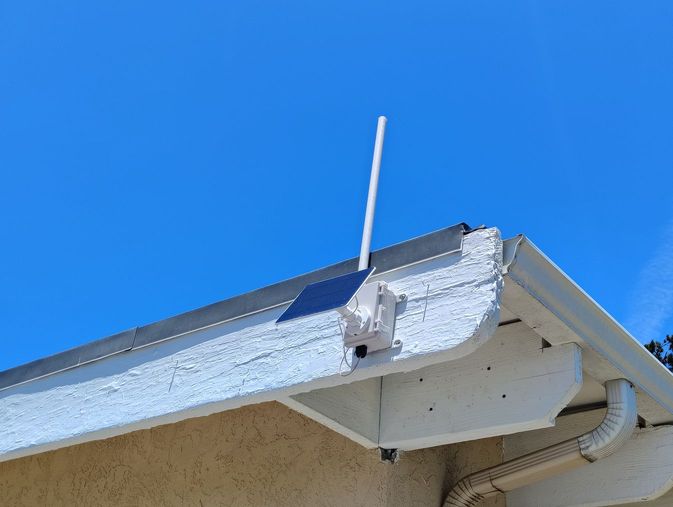
Repeaters are usually weatherproof, solar-powered, have high-capacity batteries
and are placed in strategic locations to best extend the network.
Repeaters allow communication over long distances.
A few strategically placed repeaters can extend Meshcore communication for many miles. There are currently over
400 repeaters in the Southern California region and it is not uncommon for messages to travel
anywher from Ventura County to the Mexican border and the Inland Empire.
Messages are also reaching the high desert (Victorville and Palmdale areas) and
Coachella Valley.
However, there are still dead areas that cannot reach any repeaters. Also, many existing repeaters are installed by
amateur enthusiasts in unsecured locations. To provide better coverage and redundancy, we are adding our own repeaters securely placed on church members' property.
A
solar-powered rooftop repeater
Current Community Network
Southern California already has over 700 volunteer-operated repeaters, many on mountaintops with wide coverage. Messages can travel from Ventura County to the Mexican border and to the
Inland Empire.
However, we cannot depend on existing repeaters when we need them the
most.
Any electronic equipment is subject to failure.
Adding our own stake-maintained repeaters will increase network redundancy,
which
benefits everyone.
Some areas do not have adequate coverage.
Before we installed our own repeaters, western Santee was unable
to reach the greater mesh.
The area around the Tierrasanta building is not yet covered.
Repeaters placed at unauthorized locations (hidden in parks or other open
spaces) are subject to damage, theft, or removal.
For example, some people are using LoRa technology to mine Helium—a
crypto currency. Helium miners are placing Helium repeaters in remote
locations on public and private land. Forest rangers and other law
enforcement have become wise to this practice and are aggressively
removing any suspicious equipment they find.
This is why we are building our own network of repeaters to ensure we
can communicate and provide redundancy for the rest of the network.
What messages look like
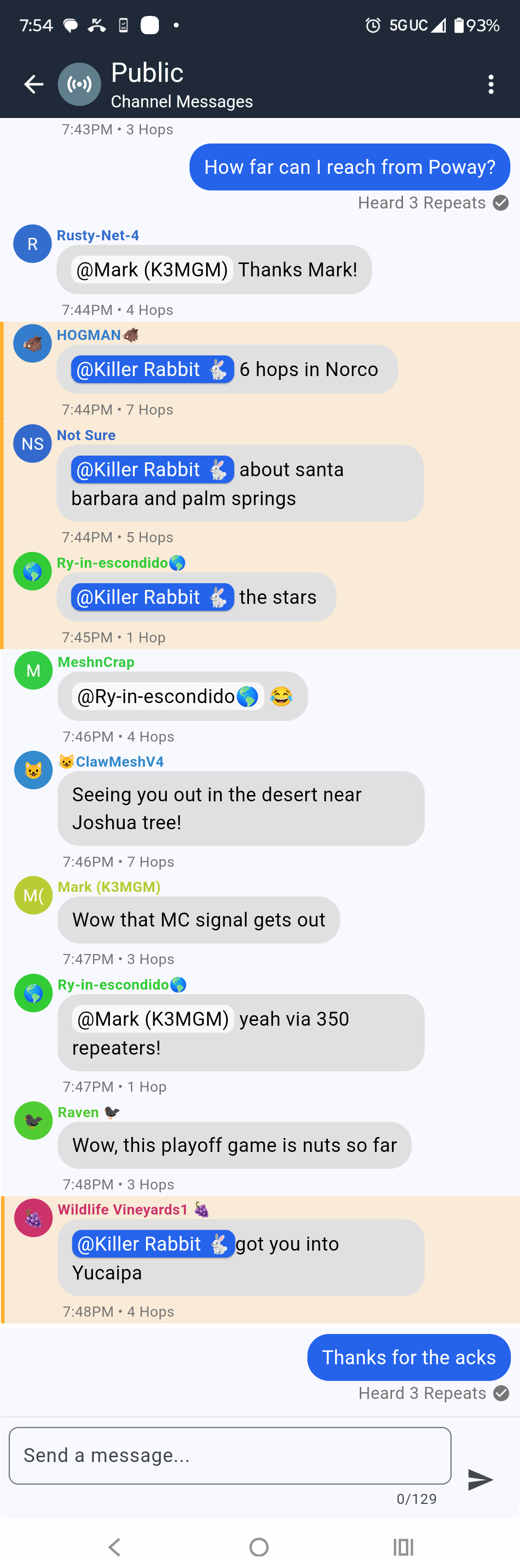
The following image is a screenshot of a series of messages. It starts with
me (while visiting friends in Poway) sending a message on the public channel to
see who replies. My message is, "How far can I reach from Poway?" My companion
node is named "Killer Rabbit." If a message starts with "@Killer Rabbit," it means
someone long-pressed my message before writing their response, indicating they
were responding to my message. Also notice that such responses have a light
orange background. It is not mandatory long press a message to reply, but it helps
operators keep
track of who's responding to whom on the public channel.
Some other messages are obviously also in response to my message, but the
operator didn't bother to long-press my message before sending theirs. Other messages are
parts of other conversations going on at the same time. After a couple of minutes, I said, "Thanks for the acks,"
where "ack" or "ACK" is short for acknowledgment. Note that I got serious
responses from Norco, near Joshua Tree, and Yucaipa..
Note that under my outgoing message, it says "Heard 3 Repeats," followed by a
white check mark in a dark circle.
This indicates how many repeaters my companion unit heard repeat my message
(this is usually repeaters that are in direct line of site). If you see
"Sent," followed by a black check mark in an unfilled circle, your companion
didn't hear any repeats.
This is a good indication of whether your message
reached the greater mesh. However, messtages can propagate without your
companion hearing a repeat. Messages may get through even if you see no repeats
or a failed direct message . On the other hand, you may see a repeat where the
repeater is unable to reach other repeater.
Approximate Costs
Companion units
Basic unit, no battery, USB power only
$25
Basic unit with battery
$35 to $40
Basic unit with high-capacity battery
$50
Water resistant unit with GPS
$55
Repeaters
Weatherproof, solar-powered rooftop repeater:
Built from scratch:
about $65 to $75
Commercially made:
$100 to $300
Personal Repeaters
Companion units can be programmed as repeaters and kept indoors.
Indoor repeaters have limited range but are protected inside homes.